
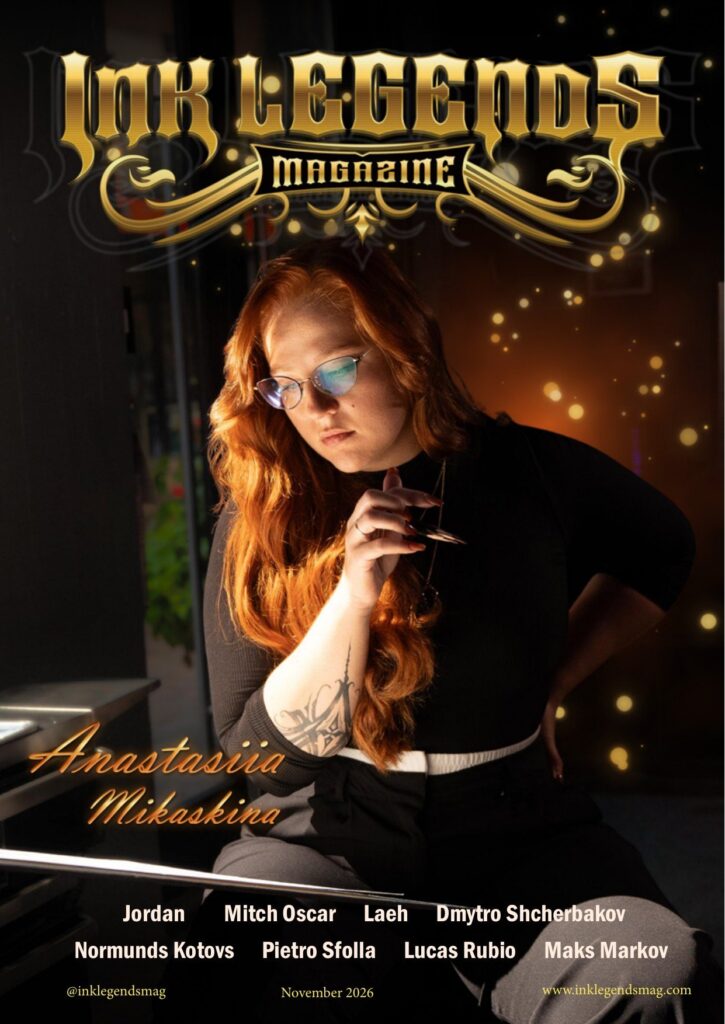
Anastasiia Mikaskina, known as Mika, is on the cover of the November 2026 issue of Ink Legends Magazine. A tattoo artist for the last ten years, she brings seven years of architectural education into her work, has tattooed across Europe and North America, and in 2025 opened Red Head Tattoo Studio near Toronto, Canada, together with her husband.
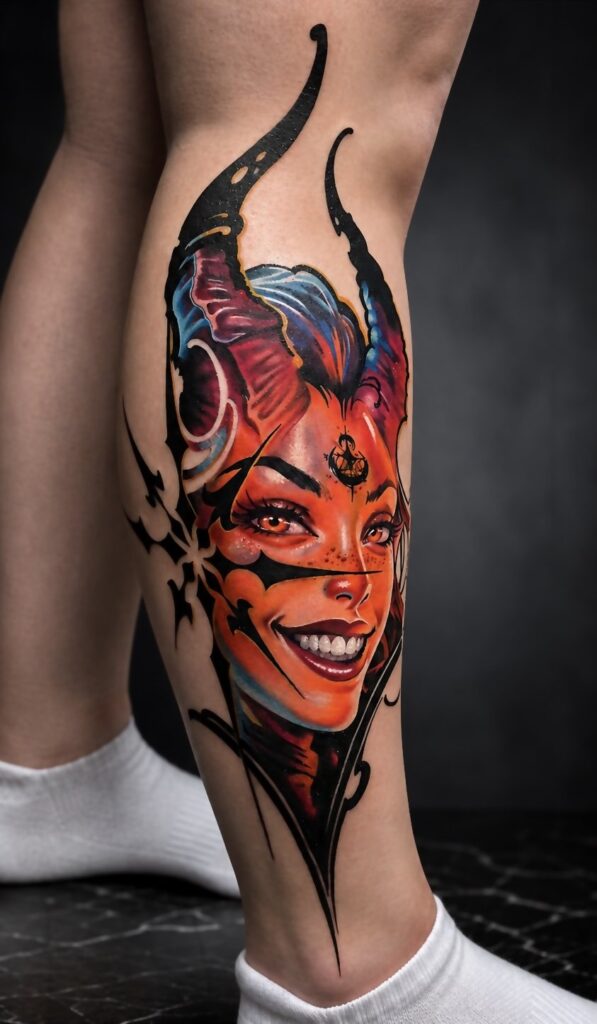
Mika specializes in color realism and surrealism, with neo-traditional equally important, combining the compositional logic of neo-traditional with the depth and detail of realism. Most of her convention awards have been in the Best of the Day category, including her recent achievements in 2026 at NIX Tattoo Show and Ink The 6ix in Toronto.
Read our exclusive interview with Mika below.
Can you please start by introducing yourself and telling us about your journey as a tattoo artist?
Hi, I’m Anastasiia Mikaskina, or just Mika. I’m a tattoo artist and the owner of my own studio. I’ve been tattooing for the last ten years, and I’m still searching for my own style.
This isn’t going to be one of those romantic stories about a kid who always dreamed of becoming a tattoo artist. No. I was a creative, very active kid who was interested in pretty much anything I could make with my own hands. I remember drawing dragons, snakes, and tribal designs on the boys’ shoulders with a ballpoint pen at summer camp. It was just fun, and even back then I preferred making them bigger because they looked cooler.
I grew up in an ordinary family. Art supplies I bought myself — almost my entire scholarship went on them. But when it came to books, I was never restricted. My grandmother believed all knowledge was in books and bought me the ones I wanted. For example, when I was about six, I picked out a book on world mythology all by myself. That interest had long-lasting consequences.
Later came seven years of architectural education with intensive training in drawing, painting, composition, perspective, form, and space. I still joke that I have my own 3D modeling software constantly running in my head, complete with a built-in golden ratio. There were also sports, dance, and competitions. I got used to measuring progress through actual results.
In 2016 my husband gave me my first tattoo machine. By the end of that week I’d tattooed three palm trees and the words Good Vibes on his wrist. That tattoo is ten years old now and we’ve left it exactly as it was. I did my first few tattoos at home for people close to me, then quickly moved into a professional studio. From the very beginning, I worked directly on people’s skin, without spending hours practicing on fake skin, and it felt natural. Over the following years I worked in Europe and North America, developed my own approach, participated in conventions, and won awards. In 2025 my husband and I opened Red Head Tattoo Studio in Canada.
Today I combine my own practice with running the studio. After ten years I’m still curious about how far tattooing can go.
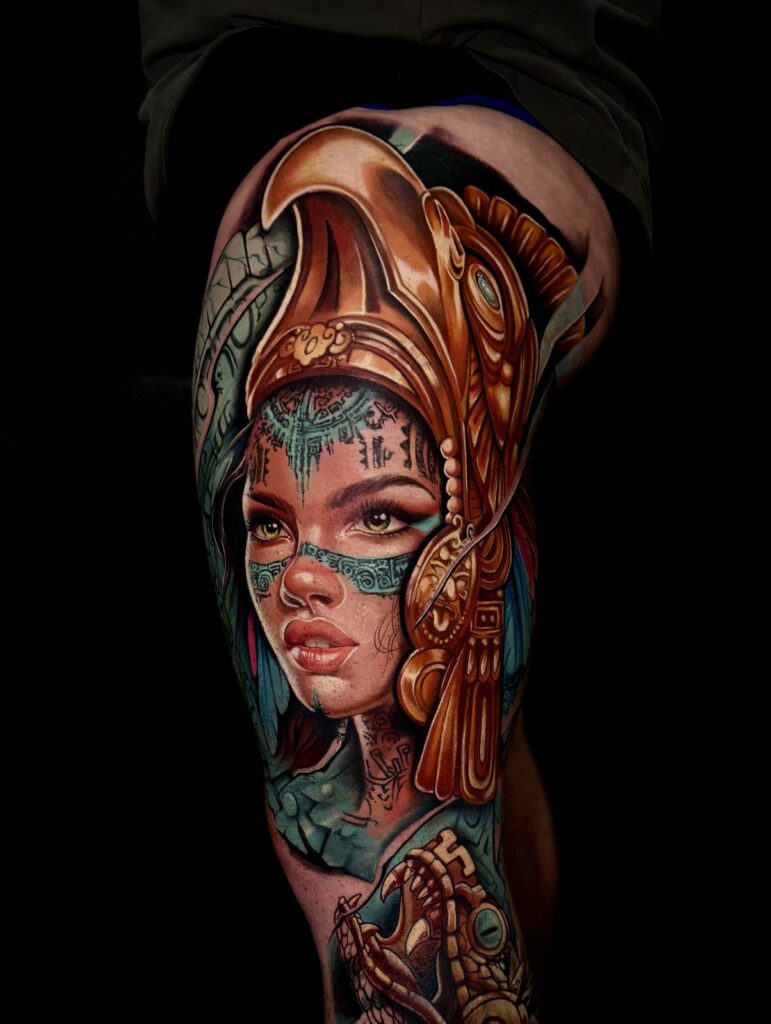
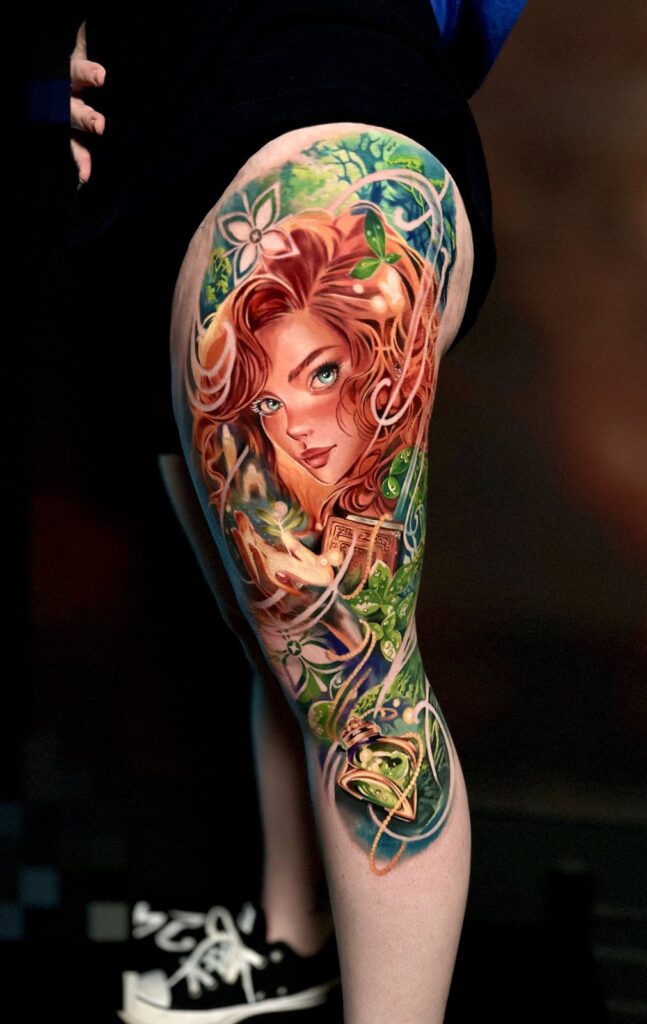
You specialize in color realism and surrealism. How would you describe your style, and what drew you to it?
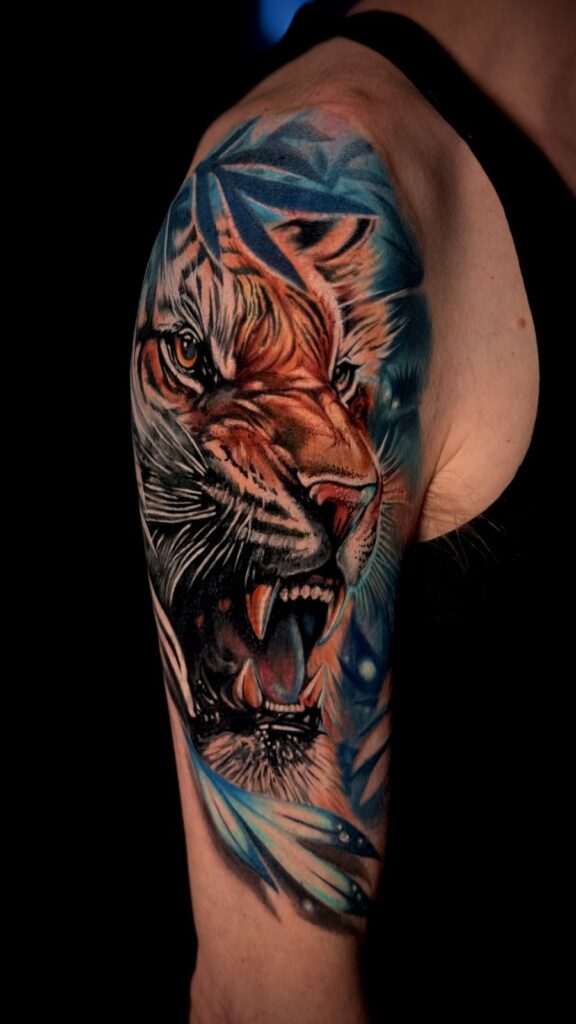
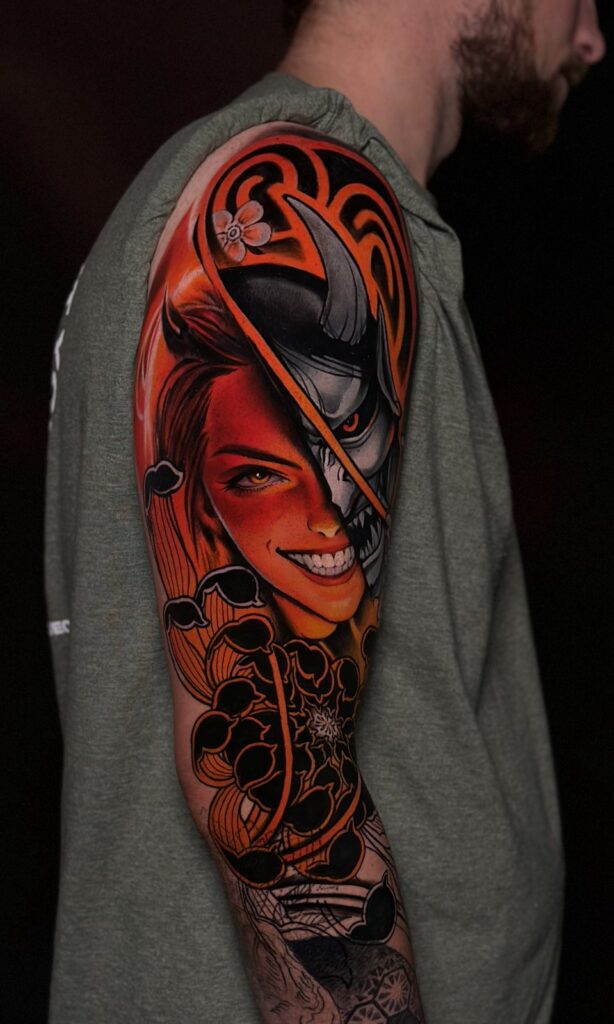
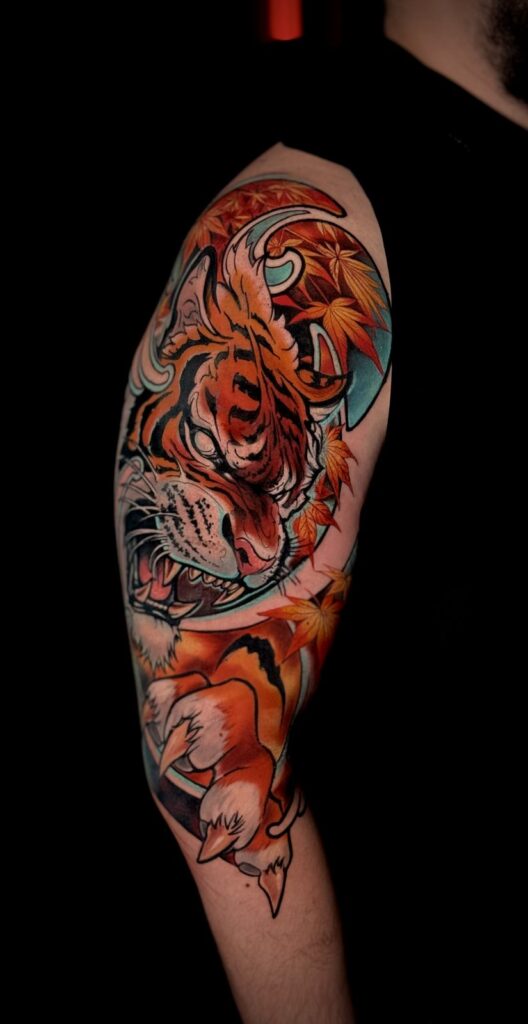
My main areas today are color realism and surrealism, with neo-traditional equally important. Realism and surrealism let me work with light, color, depth, and texture. Neo-traditional is demanding in its own way: you build the entire composition from scratch — shapes, silhouettes, lines, rhythm, and color relationships.
I’m interested in how organic forms can become part of a geometric structure. My interests never stayed in one direction. I studied traditional Japanese tattooing, Gothic art, mythology, Bosch, Caravaggio, Mucha, Bilibin, Art Nouveau, and Art Deco, alongside architecture from Rastrelli and Gaudí to Frank Lloyd Wright and Calatrava. There was always room for Miyazaki, comics, and manga.
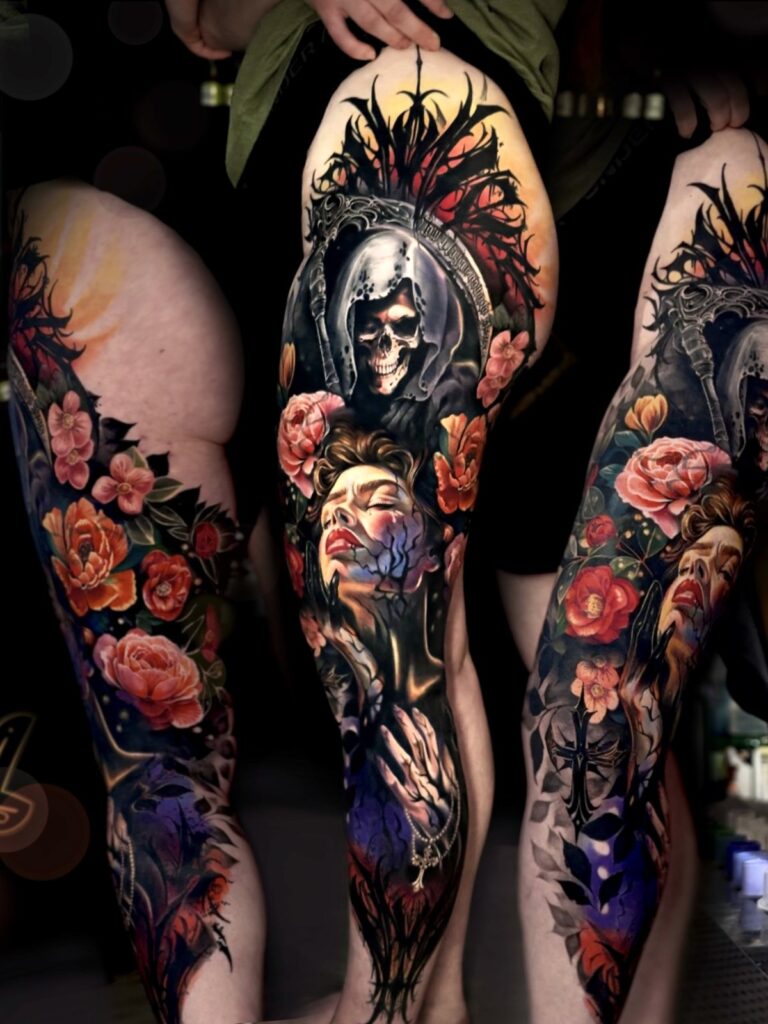
These days I’m focused on combining the compositional logic of neo-traditional with the depth and detail of realism and surrealism. Human anatomy is fundamental to large-scale work. My understanding comes from academic drawing, sports, my own injuries and rehabilitation after them, and studying muscular function, biomechanics, and movement. When I design, I consider how elements connect and how the piece reads from different angles and in motion.
I’m drawn to large-scale projects and already have concepts for full bodysuits. I’m especially interested in working with people who see their entire body as an art object, rather than just a collection of separate areas for tattoos. That opens up completely different possibilities for composition.
For me, concept and technical execution are inseparable. You can render every detail beautifully, but if the composition doesn’t work, the details won’t save it. Personal style develops through accumulated experience and visual exposure. I’m still exploring mine.
Your designs are very original. What inspires your designs, and how do you approach the design process?
Pretty much everywhere. Mythology, folklore, architecture, painting, literature, nature. Sometimes a single dry, curled leaf is enough to start a chain of associations. World mythology has a special place — I’m interested in the origins of symbols and what they mean in different cultures.
In personal projects I draw on images already in my visual world. With clients I start by understanding their stories and the meanings they want. Sometimes someone brings an ordinary reference with a fascinating idea behind it. That’s when we can rethink the composition and find an unexpected approach.
I’m systematic but also trust intuition. Sometimes the right compositional solution comes unexpectedly, and suddenly you understand how to bring all the elements together into one complete piece. Other times an idea appears and I have to capture it before it disappears.
At Red Head Tattoo we have an expression: Red Head Magic. Sometimes a client says they’ve been looking for the right artist for five or ten years. Then they find our page, we meet, and discover we have almost the same vision. But the real surprise comes when the artist takes that idea and reveals its visual potential in a way the client hadn’t even imagined. The result goes far beyond what they originally pictured. That’s where the magic happens, and where that complete trust comes from. Clients call it fate. We laugh and say, “Red Head Magic happened.” I like when that connection happens before the tattooing even begins.
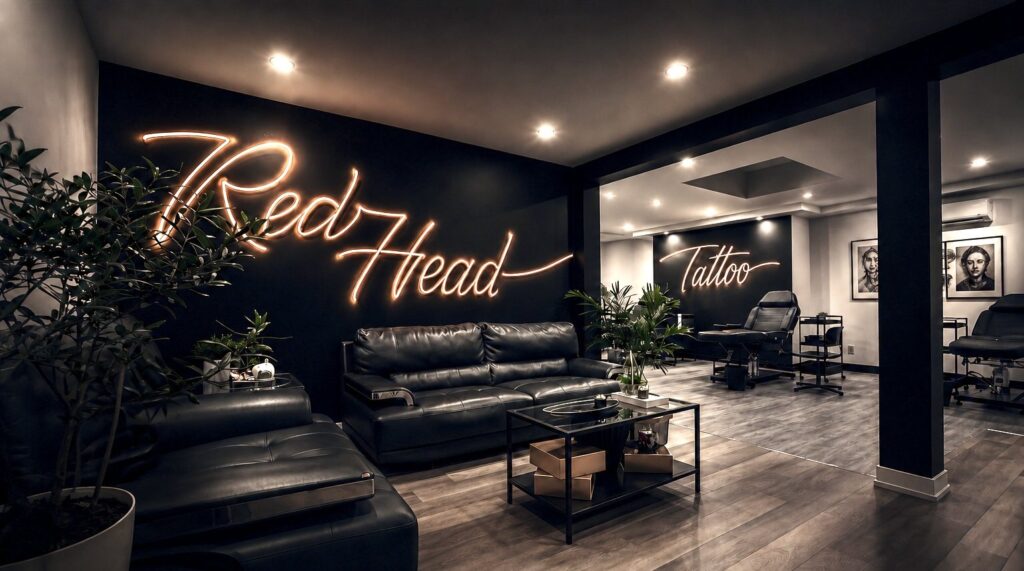
You own your own tattoo studio. What led you to create your own space, and what core values does your studio represent?
My husband and I opened Red Head Tattoo Studio together. I’d worked in different studios across Europe and North America and held management positions where European approaches to organization, communication, and professional ethics in dealing with people were emphasized. By the time we opened, I had a clear idea of the system I wanted.
Red Head brings together independent artists with different personalities and backgrounds. I’m not the kind of boss who needs to control every move. I see each artist as the director of their own department. They make decisions and take responsibility for the results. Professional freedom goes hand in hand with shared standards of quality, ethics, and client care.
One principle I’m committed to is freedom of choice for both sides. That’s why our communication with clients starts with a consultation. A consultation is a two-way interview. Neither side is obligated to commit. An artist can decide if a project is right or recommend a colleague; the client can consider different approaches. What excites me more is when a client chooses a collaboration between two artists on the same project.
Red Head is also a working art space. We create original paintings, exhibit work, and use the studio as a gallery. One client saw the concept for a painting and purchased it before it was created. We agreed on a timeline, and once finished it went into a private collection. Another client noticed an abstract painting by a colleague during a session and commissioned a larger piece with the same atmosphere for his home. This is one of the things I love about our studio: someone can come in for a tattoo and discover an entirely different kind of art. They can enjoy both without having to limit themselves to one artist.
My husband and I divide responsibilities according to who’s best suited. When I delegate, I’d rather explain the method and criteria than hand over a step-by-step list. Choosing artists is always a mutual interview. I sometimes say a good tattoo artist is like a cat — they know where they feel comfortable and keep coming back.
We chose a location close to Toronto but far enough from the downtown rush. I wanted a place where we could focus on large projects, have proper conversations, and give every client attention. It’s more than receiving a service. It’s an opportunity to connect directly with the artist creating something you’ll carry.
Was there a turning point in your career that significantly improved your work, whether it was related to equipment, education, or technique?
There wasn’t one dramatic turning point. It was a series of small discoveries. I remember a friend with over twenty years of experience watching me experiment. He looked at what I was doing, walked to the drawer, and silently placed a different cartridge in front of me. No lecture. Just the right tool. It was a technical discovery and a clear example of professional respect.
Equipment was another part. My husband is an engineer, so he quickly figured out the technical side and started buying high-quality machines. The logic was simple: if you’ve got good equipment, you can’t blame a bad machine for your mistakes. That keeps you accountable.
The most interesting limits are still the ones inside yourself. Sometimes you know how something should be done but haven’t tried it. You just have to trust your knowledge and take the step. There’s a saying I like: “The eyes are afraid, but the hands get the job done.” I enjoy testing the limits of my own abilities. As long as there are new challenges, there’s room to grow.
You’ve received prestigious awards at conventions. Which of these recognitions has meant the most to you, and how have they shaped your journey as an artist?
I’ve been competing since my sports and dance days, so the atmosphere feels natural. At conventions I’m almost completely focused on tattooing — three days of intense concentration, trying to produce the best work under those conditions. Sometimes I barely have time to walk around. That’s exactly what I enjoy.
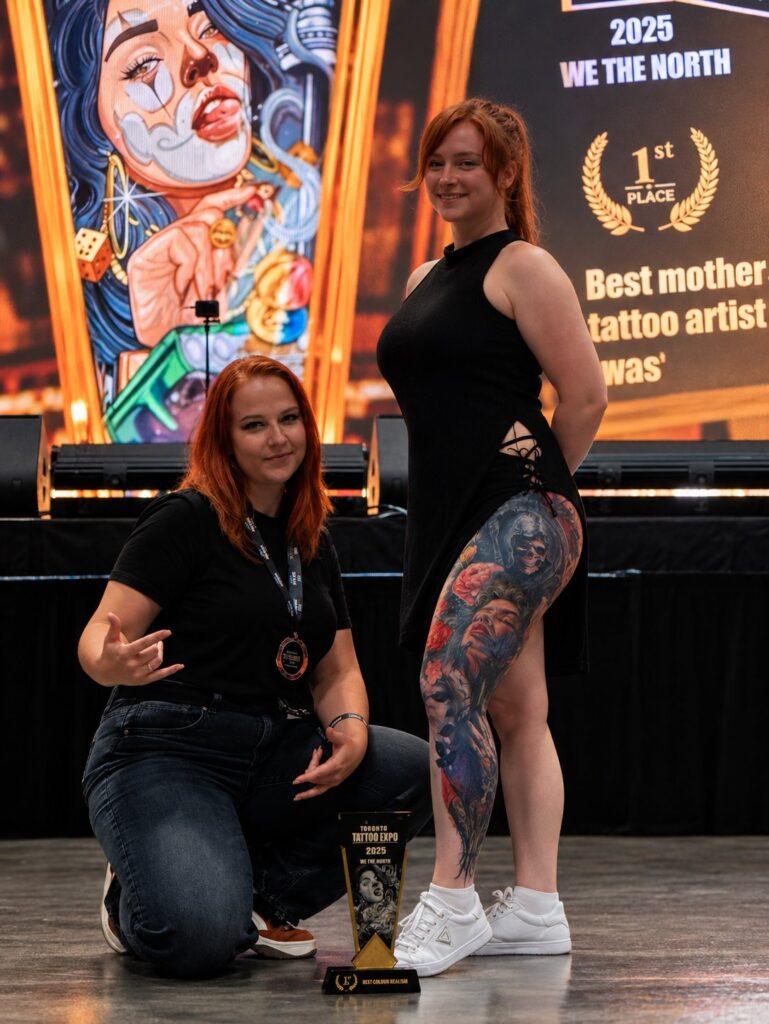
Best of the Day is the category I connect with most. It recognizes what an artist can create right there, in the moment. Judging is subjective, with individual preferences and an element of luck. That’s part of competition. Most of my awards have been in Best of the Day, including my recent achievements in 2026 at NIX Tattoo Show and Ink The 6ix, two major international tattoo conventions in Toronto.
The professional community is just as important. Conventions are a chance to see friends, meet new people, watch other artists work, and exchange ideas. Sometimes we make plans to work together. Those connections give me energy for both my own work and growing Red Head Tattoo. I like being part of the international community, where competition is a normal part of professional life rather than a constant need to prove yourself.
Surrealism lets you go beyond the literal. What draws you to surreal imagery, and what do you hope it evokes in the people who wear and see it?
For me, surrealism is the emotional side of realism. Realism lets you depict the world convincingly. Surrealism uses that same credibility to reveal thoughts and meanings beneath the image. I love visual contradictions — when something disturbing unexpectedly brings warmth or a smile. Straightforward horror doesn’t interest me much. I’m drawn to fairytale and mythological surrealism, where a single image can work on several levels.
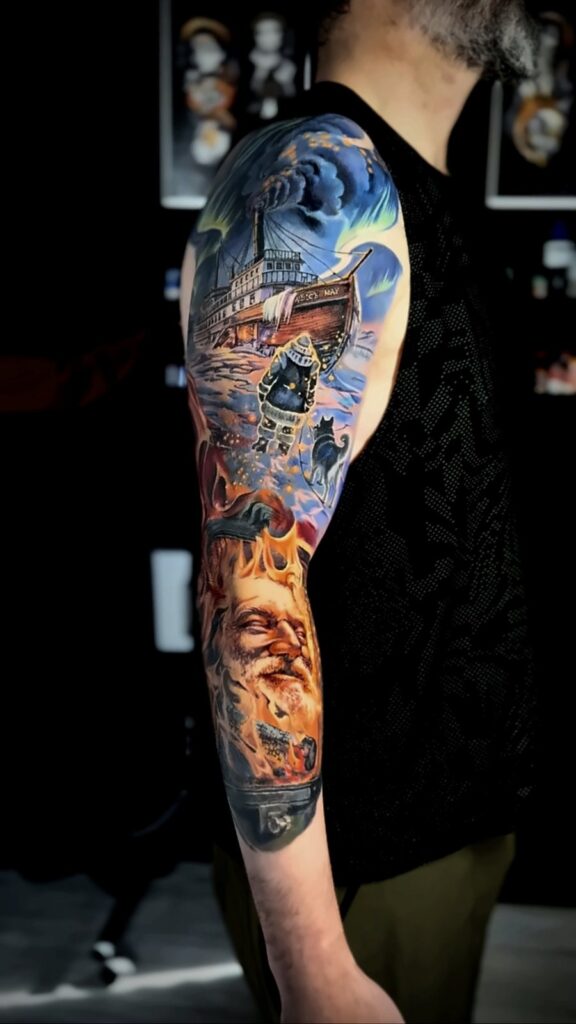
A good example is a tattoo based on Robert W. Service’s poem The Cremation of Sam McGee. My client introduced me to the story. A man promises his freezing companion he’ll cremate him after death. He keeps the promise, but when he looks inside the furnace he finds Sam perfectly happy — he’s finally warm. I love the contrast: cold, death, fire, dark humor, and this unexpected feeling of happiness. I could have illustrated the plot literally, but I wanted the emotional paradox. That’s how I arrived at the central image — an old man’s face smiling in the flames. He’s dead, being cremated, and somehow finally happy. I like when people notice the contradiction, stop, and try to understand what’s happening. In work like this, realism becomes a storytelling tool rather than the end goal.
What do you enjoy most about being a tattoo artist, and what still challenges you the most today?
The hardest part today is that you can’t just be a tattoo artist. Being good at drawing and tattooing isn’t enough. You also need social media, marketing, photography, video, editing, and communication. When you own a studio, add management and entrepreneurship. You end up a one-person production team. Eventually you get good at it — you learn another profession just to support the one you chose.
What I still love most is tattooing itself. When I’m deep into an interesting project, working with composition, color, form, and technical decisions, everything else disappears for a while. I also love that there’s still so much unexplored potential in color realism and surrealism.
And then there are the people. Even when you stay in one city, the whole world can end up in your chair. Some clients fly across an ocean to work with me. It’s especially meaningful when clients who collect contemporary art return for another piece. That shows they see the tattoos as works by an individual artist, not simply a service. There’s also the professional community — exchanging experience and discovering new possibilities. It’s art, business, and an international community all at once.
Do you have any special or exciting plans in the near future?
Plenty. It’s mostly a question of timing. I’ve already done guest work in Europe and North America. Now I’m particularly interested in Asia and South America. Those trips would also help me find possible future locations for Red Head Tattoo Studio. I don’t want to choose a place based on commercial potential alone. I need to feel its atmosphere, get to know the people, and understand the local community. Every location should have its own character.
I’d like to build a network where artists can move between locations. Workstations, equipment, supplies, organizational support — everything is ready. You arrive, and you work. For clients, that means the same high standard of service at any location.
But expansion isn’t just about opening more studios. Our current model works well with established independent artists. The next challenge is developing a system of training and growth that supports artists at different stages without turning management into constant supervision. Each studio should keep its own atmosphere and the individuality of its artists.
Long term, I’d love to build an international brand connecting creative spaces through shared professional values. Alongside that, I want to keep developing my own art, attending conventions, and exploring new directions. I don’t see why I should have to choose just one.
What are your hobbies and interests outside of tattooing?
It might be easier to list the things I’m not interested in. I’m constantly creating something. Drawing, painting, sculpture, experimenting with materials and techniques. Right now I’m exploring traditional Chinese painting, and I’d love to spend more time with oils. Outside of art, horses and equestrian sports have been part of my life for as long as I can remember. I love being on the water. My family and I have our own boat, and we’re planning longer trips. I’d also love to learn to surf someday.
Music is a relatively new interest. I’ve put together a small collection of instruments, including the handpan. I still dance occasionally, ride motorcycles, and enjoy watching my husband restore our classic muscle car. One thing I’m not a fan of is the modern idea that every hobby needs to be shared online or turned into income. Some things I prefer to keep purely for the pleasure of doing them. And somehow all those interests still find their way into my professional work. Sometimes the most interesting ideas come from places you’d never expect.
Author: Lenka Banyarova, published on November 3rd.