
Alex is an Italian tattoo artist based in Chicago, USA, with a strong background in fine arts. After studying in Italy and building experience through international conventions, guest spots, and years of studio work, he developed a versatile style that blends light realism, abstract composition, brushstroke techniques, and Asian influences.
In this exclusive interview, Alex shares his journey into tattooing, his evolving artistic direction, and his thoughtful approach to cover-ups, restyling, and scar cover-up tattoos.
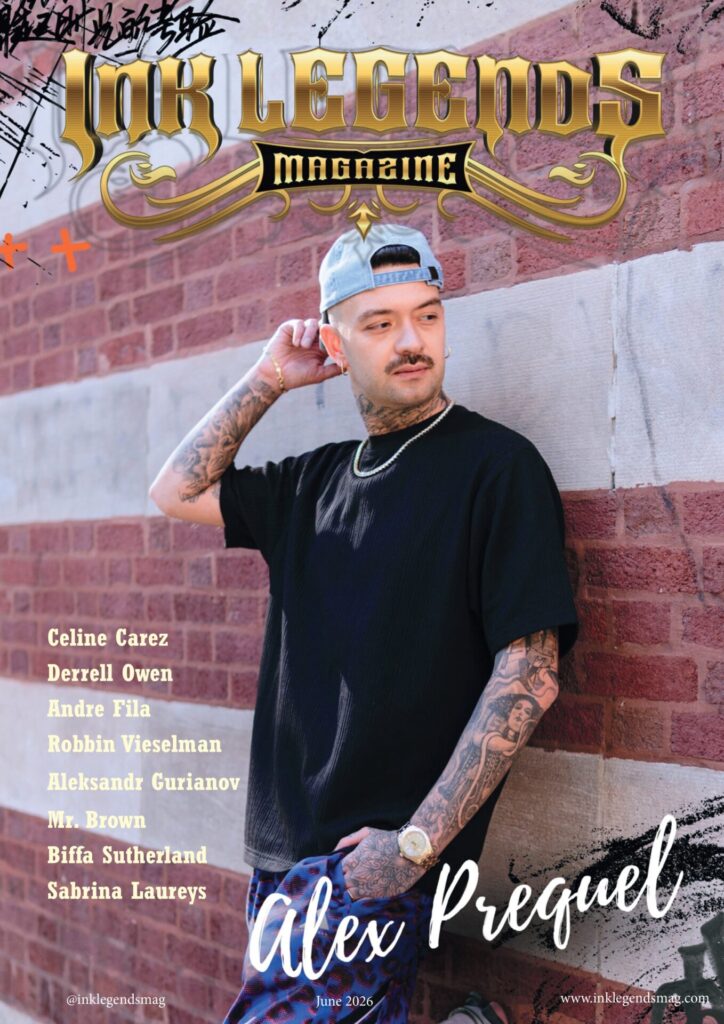
credit to photographer Arturo Toledo @at_photographer1
Can you please start by introducing yourself and telling us about your journey as a tattoo artist?
I discovered my passion for drawing at a very young age, when sketching first became a natural way for me to express myself. That early curiosity eventually led me to pursue a formal education in the arts in Italy, where I attended an Art High School. During those years, I developed a strong foundation across a wide range of artistic disciplines, including live portraiture, acrylic painting, charcoal drawing, and clay modeling. Exploring these different techniques helped shape both my technical skills and my artistic identity.
After completing my studies, I transitioned into tattooing around 2013, seeing it as a powerful extension of my background in drawing. What began as an experiment quickly became a true calling. In 2015, I opened my own private tattoo studio, which I successfully ran until 2021. That same year, I decided to expand my horizons and moved to Toronto, where I spent several years continuing to grow both professionally and creatively. I am now based in Chicago,USA, where I continue my work as a tattoo artist.
Throughout my career, I have had the opportunity to participate in numerous international tattoo conventions and guest spots, connecting with artists and clients from around the world. My work has been featured in several tattoo magazines, and I have been honored to receive multiple awards for my pieces.
I was initially drawn to tattooing because of my foundation in drawing, but what truly captured me was the unique and deeply personal nature of the medium. Art has always been fascinating to me, but there is something profoundly different about creating work that lives on the human body. Tattooing is not just visual—it is emotional, permanent, and deeply connected to individual stories. That connection is what continues to inspire me, and it is why I remain passionate about contributing to this art form every day.
Your style is very versatile. How would you describe it, and what are your main areas of specialization?
Absolutely—I’m deeply committed to keeping my style contemporary and evolving. My work often incorporates abstract elements, layered textures, and a strong sense of experimentation. Rather than confining myself to a single category, I prefer to explore a range of visual languages that intersect and inform one another. I often describe my style as a blend of light realism, abstract composition, and brushstroke-inspired techniques, with a noticeable influence from Asian aesthetics.
More recently, I’ve been expanding my work into areas inspired by Kintsugi and jewelry design, integrating ideas of reconstruction, contrast, and ornamentation into my pieces. While my approach is highly versatile and constantly developing, there is always a cohesive thread that ties everything together—an underlying balance between structure and fluidity that defines my artistic voice.
In addition to creating original pieces, I also specialize in restyling, cover-up work, and scar cover-up tattoos. These projects require a thoughtful and highly customized approach, as each situation presents its own unique challenges. Whether it’s reworking an older tattoo to better reflect a client’s current vision, or carefully designing a piece to seamlessly conceal existing ink, my goal is always to transform what’s already there into something meaningful and visually cohesive.
Scar cover-ups hold a particularly important place in my work. These tattoos go beyond aesthetics—they often carry deep personal significance, helping clients reclaim and reinterpret their bodies through art. I approach this process with sensitivity and care, taking into account the texture and condition of the skin while designing something that not only integrates naturally but also empowers the individual.
Across all of these services, I focus on creating results that feel intentional, balanced, and aligned with my overall artistic style, while still honoring each client’s story and vision.

How important is the connection with your clients in your work, and in what ways does it shape the final result ?
Connection with my clients is a fundamental part of my process. Tattooing is not just about creating something visually strong—it’s about translating a person’s story, emotions, and identity into something permanent. Without that connection, the work risks feeling surface-level.
I take time to understand what the client is looking for, but also what sits behind their idea—the meaning, the mood, the reason they want to carry that piece on their body. That dialogue allows me to design something that feels truly personal rather than just aesthetically pleasing.
This connection directly shapes the final result. It influences the composition, the flow on the body, the textures, and even the level of abstraction or realism I choose. Especially in projects like cover-ups or scar work, trust and communication are essential—they allow me to push creative boundaries while still making the client feel comfortable and represented.
How do you approach the design process when balancing your artistic vision with your client’s ideas?
I see the design process as a collaboration where both perspectives are essential. The client brings the idea, the meaning, and the intention behind the piece, while I bring my artistic language, experience, and understanding of how a design will work on the body over time.
In any case, I have a lot of people who give me plenty of creative freedom—on abstract work, for instance—and many clients who choose my flash designs; so, in those cases, the approach is faster and freer.

Has there been any recent project that challenged you and made you feel especially proud of the final result?
It was a full sleeve in the Kintsugi style—a style that was quite new for me to tackle—and it was certainly one of the projects, after a long time, that featured such a wide range of colors.
What’s the next step for you in your career, and is there anything exciting you’re currently working toward?
Looking ahead, I’m interested in creating more curated projects—pieces that are not just individual tattoos, but part of a broader artistic vision. Whether that becomes a collection, collaborations, or something more conceptual, I want to keep pushing beyond the traditional boundaries of tattooing.
Overall, the next step for me is growth—technically, creatively, and conceptually—while staying true to the identity I’ve built so far.
Do you think your work reflects your personality? In what ways does your character show through your tattoos or the way you work?
Certainly—though this might be a perspective best offered by an outsider looking in—I do believe that it does. In terms of my workflow, it definitely reflects my nature: I am precise, punctual, and meticulous. Whether it involves pricing, designs, or other details, the client needs to know everything upfront—just as I need to know everything before the appointment, or even before I begin drafting the design. For instance, there are many other tattoo artists and colleagues who only show the design to the client on the day of the actual appointment; to me, that is simply inconceivable. My clients see the design beforehand, and by the time they book their session, they already know exactly how much it will cost—there are no surprises. Personally, I couldn’t walk into an appointment without knowing what to expect; and, putting myself in the client’s shoes, I know I wouldn’t be able to wait until the very last minute to see my own project design. But that is just my personal perspective; everyone works differently, and I certainly wouldn’t want to take anything away from the methods of others. As for my tattoos themselves, I think they, too, reflect a bit of my artistic sensibility—specifically, the things I know I enjoy in life. However, I’m not sure if that comes across to those viewing my work from the outside—and even if it doesn’t, that’s not a problem at all.:)

Have you experienced any turning points that significantly shaped you as an artist?
Yes, I think my path has been shaped by a few key turning points rather than a single moment. One of the first was my academic training in Italy. Studying classical art gave me a strong technical foundation, but more importantly, it taught me discipline and how to really observe. That still influences everything I do today.
Another major turning point was when I started tattooing. Translating drawing onto skin completely changed the way I think about art—suddenly, it wasn’t just about composition on paper, but about flow, movement, and how a piece lives on a body over time. That shift pushed me to adapt and rethink my approach in a deeper way.
Opening my own studio in 2015 was also a defining moment. It forced me to grow not just as an artist, but as a professional—learning how to manage clients, build trust, and develop a clear artistic identity.
More recently, moving abroad—first to Toronto and now to Chicago—has been another important step. Being exposed to different cultures, clients, and artistic environments challenged me to evolve, refine my style, and step outside my comfort zone.
All of these moments shaped me in different ways, but they have one thing in common: they pushed me to grow. I think that constant evolution is what really defines me as an artist today.
Apart from tattooing, how do you like to spend your free time and recharge?
I am passionate about music and have been collecting vinyl records for a few years now—a passion of mine outside of tattooing. I’m also an urban explorer; I really enjoy wandering around the city—usually as a way to recharge. For this reason, vacations or trips to beautiful places tend to work best for me, as they allow me to truly disconnect from my phone, work, and everything else.


Written by Lenka Banyarova, publish June 8th 2026